Monday, April 4, 2011

Breaking News: I won't have Joe Sweeney to kick around anymore

Literally the very moment I was driving to Phoenix to catch a flight back home after a wonderful stay in the Old Pueblo, Joe Sweeney, the perennial old crank, one-issue candidate for office in Tucson, died! That issue: illegal immigration. (Joe was very much against it.)

Joe's message and politics were utterly repellent: anti-immigrant, anti-gay, racist, and bitter--he was a sort of one man tea-party, where absolutely no one was invited. What impressed me about Sweeney--and it's not a kind thing to say--was that he just may have been as physically ugly as his political convictions.


In all of his campaigns for the House, there were two constants: anti-immigration vitriol and this ridiculous picture.

Joe Sweeney: "This country: an ideology worth repeating!"*

I knew nothing of his politics the first time I saw the poster emblazoned with this image, but I soon saw it everywhere I went, and it became a constant nagging presence on my daily commute during campaign seasons. After a couple of even numbered years, one of my friends gave me his business card, which carried the same photo. I even acquired one of Sweeney's campaign signs, which I kept where no one would ever see it.

Over the years since I left Arizona, Sweeney's fortunes soared. He renewed his campaigned every election cycle, hosted a public access call in show, and by the 2000s, despite his 3rd party affiliations, explicit racism, and belief in UFOs, he was being taken seriously as a republican candidate, winning GOP nomination in 2006, but losing the election.

So goodbye, Joe. I hope your immigration to the other side was legal and abrupt.

AZ Daily Star news item

Tucson Weekly RIP Joe Sweeney

Wednesday, October 7, 2009

Community Theatre Review

And so, last year, I went to a theatrical event that I did not much enjoy. I will not name the play or the venue so that I can liberate my tongue. However, I believe that the empty feeling it left with me may well have been the most productive thing that to ever happen to me in a theatre.

There is something positively post-apocalyptic about community theatre. That is to say, no other art form more adequately creates an impression of a world that can only vaguely remember what entertainment is. The whole experience with posits "entertainment" as a distant, past-tense thing, something long gone that can only be recalled through empty restaging. The experience is one of scavenging, with a death knell still echoing in your ears.

The actors' every gesture is in pastiche of something imprecise: dull recitation of stayed dialogue delivered between sitcom mugging ("Mugging"--the only thing they're stealing is dignity) and the varied contortions of body desperately unsure of its performance. Everything from the form of the spectacle--curtain, stage, seats--to the name of the event calls up notions of entertainment, the verbs "to entertain" or expection of "being entertained", but these ideas quickly vanish like smoke ring traces wafting away into the impossibility of what is delivered.

It is imitation so barren, so lacking cue to its source, that it forestalls any attempt at constructing even the vaguest of genealogies: Neil Simon's name may be on the programme, but one gets no sense from the play that a Neil Simon, Brooklyn, or Jewish comic tradition ever existed.

Leaving the theatre, I had the feeling of a world raised of purpose, but carrying on in spite. It was like church without God. In that instant--standing in the eeriely quiet empty wet street in distant part of town, holding half an egg salad sandwich that had been served to me from tray held by a member of cast after the show--there was the odor of pure possibility in the air: an infinite "what-now?" that in its very persistence can only amount to some kind of liberation. I was truly free.

All this comes to mind as I learned, that the same theatre is staging another production soon. Anyone interested in joining me?

Wednesday, July 15, 2009

POSTCARDS FROM THE HEDGE: Visiting Canada 1939

NEW FEATURE!

As newspapers around the world continue to fold, one paper product for the most part resists being folded: the postcard! In the coming weeks, I'll be offering up a few for your greedy eyes.

First, the Queen. Not this queen. Her mum. The Queen Mum. From her pre-war visit of 1939 to Canada, here in a card mailed just under a month after the start of the war in Europe.

Visiting Canada - front

Postmarked 12 Oct 1939
Sent to Illinois

Visiting Canada - back

The message:

Well I suppose you'd begin to think I could not write but I'll be back in Dec. if I can make it.
Harlan


The innocuous image of His and Her Majesty's stately visit to Canada belies the story of a man named Harlan somehow detained in Canada a month after the start of the second World War. I found it at an antique shop in Tucson, Arizona. No word on what became of Harlan.

~ THE HEDGE

Thursday, May 14, 2009

DAY TWO: Mediated Memphis

Keeping with the times, this is a heavily mediated trip. For at least as long as the motels have WiFi, I'll regularly be making twit of myself.

Today, we got to Memphis proper late in the afternoon.

The air here is thick, hot and wet.

We saw the mighty Mississippi and many of the city's sociable homeless population. Beale Street was an interesting mix of crash commercialization (W.C. Handy is brought to you by Pepsi) and dire poverty (homeless + tourists + drinking on the street). A friend told me that there was only one business open on Beale Street in 1982, but now it's wall-to-wall blues clubs and souvenir stands, but it still has an air of its former rundownedness.

Of course, it's America so everything is humongous, puffed up with an odd mix of pride, insolence, sloth and decay. At the same time, it is full of wonder and surprises. The world-famous Sun Studios (home of the first recordings by Elvis Presley, Carl Perkins, Johnny Cash, and many others) looks isolated, standing on a sharp corner across from a park that has a statue of Confederate hero and KKK founder Nathan Bedford Forrest.

Even Graceland snuck up on us, its trim immaculately-landscaped plot smack in the middle of a bleak strip of 25c carwashes, chicken shacks, discount liquor stores and coin-op laundries. (We will take the formal Graceland tour tomorrow and wash our clothes in another town).

I hope the Google earth/world people document everything here. I would actually enjoy just reading the Memphis phonebook for the names of local businesses, which to an over-educated semi-Waspish Canadian city boy seem downright exotic (lots of Catfish, Chitterlings and other Southern food names).

In that vein, and in the words of Noel Coward, I like America.

Wednesday, May 13, 2009

Day One: Go! Go! Go!

TODAY begins the research trip I've been promising myself and putting off since 2006 or so. The Big Bucolic Buford Pusser Road & Air Show will take us through Memphis TN > Selmer TN > Adamsville TN > Tupelo MS > Birmingham AL > Montgomery AL > Phenix City AL > Columbus GA and beyond. I know not what to expect or which distractions to avoid or which to embrace (e.g., Conway Twitty's Twitty City is just north of Nashville, near Dollywood, the International Rock-a-Billy Hall of Fame, Jackson Tennessee, etc).

The beginning leg of the trip will be rain thunder down from the sky. A rain-soaked rural south might have a primordial quiet violence to it. It would be appropriate, as the thrust of the trip will be to investigate what remains of the cult of Buford Pusser.


As for now, we're trapped in the wiles of Burlington VT and their charming little airstrip. There are aeronautical delays and I'm downloading 20 versions of Del Shannon's Runaway from a music blog and wondering why people shout into cell phones in moments of extreme idleness.

Monday, September 22, 2008

David Foster Wallace

I found this cheerily infuriating.

The Best Mind of His Generation

This was written by the sometimes Roeper aislemate and NYT film critic, A. O. Scott. I guess it's written from the perspective of gen-Xer writing to about and at the wicked boomers who took all the good jobs, lived the good life and got everything the slacker generation never could. Boomer privilege and entitlement is old hat, but if Tony Scott thinks there are no vacancies at this point in history for great men of literature, I recommend he check in and see how someone born in 1980 or 1990 feels about our prospects. In all honestly, perhaps what is meant by literature itself--that stodgily stuffy edifice and its leather patchwork of hierarchical brows (sub-simian to brainiac)--has outworn its usefulness as a cultural form. It certainly has faded as a worthwhile distinction--this I know from experience.

I studied Creative Writing where David Foster Wallace got his MFA.

In the institution's hallowed halls, Wallace was revered, if sometimes begrudgingly so (I'll get to that). The reverence was grad-student driven, but it did reach the top. Wallace was one of them/us, or had been, and seemed like the prototype of someone who made good of this wickedness.

The first time I heard his name, I was young and impressionable and eager to believe that there was good writing out there, but not seeing it anywhere around. I'd submitted a fantastically mediocre poem to a poetry workshop headed by an energetic young grad student called Julian with frosty hair and Buddy Holly spectacles. On reflection, there was a quiet mentoring going on there, the closest that I would ever get, artistically. He good poet, and seemed to have his life together. It was hard not to see him as the image of what I might wind up being, and I think he respected my clumsy cynicism and earnestness. He didn't really help me out anywhere specifically (Lord knows I could have used it), but he told me I was good and he let me get away with trying to remain as anonymous as possible while giggling my way through the semester.

Julian did his best with what week to week proved to be a lousy group of writers (myself included). A few times, he would bring in friends and local writers to our little section during critiques to give us some sense of occasion. One time, he brought in this really smug and serious writer with a small ponytail, the kind of guy who spends a set amount of each day mugging for a dust jacket photo, trying to capture just the right supercilious turn of the nose. This guy read everyone's poems and at the end of the week he chose a few people for critique. I was among those selected, and when he called my name I answered sheepishly, having heard him tear people to pieces. When he got to me, he only asked me, "Have you read David Foster Wallace?" I hadn't and said so. "You might want to." And that was it.

It sounded like it was intended as a compliment, it was enough to set me off through Wallace's oeuvre--penance for escaping without the nicely worded verbal abuse everyone else got. I read everything I could get my hands on, and despite the circumstances of our introduction, and as testament to Wallace's skills, I enjoyed most everything. It was immediately accessible and familiar and miles ahead of anything I might ever hope to do.

Later, I got to see him read. It was one of the more sensible and dazzling moments in my university career. Wallace's reading was blank, he read very straightly and simply.

The evening's power was entirely in the text, which somehow had been written by the imposing figure at the front of the room. The auditorium was filled with enthusiastic admirers, clutching copies of his books, which I had to that point only checked out of libraries. I approached him afterwards and merely told him that I liked his work and thanked him for coming. He was quickly distracted by a more exuberant fan, but seemed to acknowledge it. By this point a queue was forming for autographs, but I stood by and watched him interact with people. He was shy but gracious as people lavished praise.

The next day, I was trapped in an insipid fiction workshop taught by a dinosaur who thirty years earlier had written a book about going blind, imaginatively titled Going Blind. He was an unpleasant and demanding man with cruel hair and wrinkles that told me he only smiled through sheer force of will. Worse, he graded harshly. He clearly detested undergraduates, and to explain his arcane view of literature, he would frequently trot out another of his mouldy scribblings: a piece on the importance of the distinction between literary and popular fiction. Popular fiction, he explained, was about outsides. Literary fiction had the singular gift of being able to give us insides. To prove his point, he then had a series of strawman examples drawn from the 1970s when it was written: Jaws versus The Old Man and The Sea; Clan of the Cave Bear versus The Inheritors, etc. He also detested the cinema (which he said could only show outsides), women and anything else that might be considered fun.

(When he got into it, I usually distracted myself with the thought of one day getting inside one of my fellow classmates.)

About half-way through class, someone asked him what he thought of Wallace's lecture. He paused, measuring how his words would be received--as if endorsing Wallace's playful genius would open the floodgates to hollow imitations, as if his words could carry such weight with a room that feared and hated him--then he said, "Oh, I liked it." This was followed by a string of qualifying buts that amounted to nothing all. He basically said that Wallace was really good at what he did, and we were and could not. Fortunately, I was distracted by the fact that the girl sitting across from me appeared to have forgotten to, or wasn't wearing underwear.

I've never had a teacher who tried impose his point of view on me as strongly as this blowhard. Still worse, he used grades for leverage. He only gave out one A-, and only because he'd misread one girl's story to have depth beyond her design. I worked my ass off to get a B, and by the time I did, I was less sure of myself and less capable of putting my ideas into words than I had been when I'd started out writing as a teenager. The material suffered. I forgot how to be playful and clever and it stopped being fun. I stopped being fun. I stopped giggling on the page. I walked away from the whole experience never really writing seriously again. (Well... one time, but that launched the biggest fiasco of the personal underwear-based kind.)

He had not talked about Wallace with admiration. He merely condoned that what had been read was indeed literary (he failed to explain how, suggesting we re-read his essay). This is the nature of the praise that is available in this dark coven of self-important twits in creative writing. And Tony Scott is playing right into this dinosaur's hands! By essentially writing David Foster Wallace off as a casualty of some post-boomer world, in which there's no room for him in the pantheon of literary genius and the only aspect of the human condition left unexamined is that of pitiable exile, Scott makes Wallace's life and death seem all the more hollow.

I don't quite buy it. It doesn't seem right to evaluate Wallace along any grand continuum, even if that is where he saw himself. It distorts Wallace's significance and short-changes his generation. The fact was that he was able to remain relevant and hip to his peers and people who came after him, becoming the index of what good writing at this moment in history would look like, while still begrudgingly gaining acceptance from elite. That's what he was to me anyway. It's no small feat. It seems clear that Wallace's suicide was a tragedy of circumstance and the unfortunate treatment of mental illness. Scott's dim epitaph almost makes me want to not read the few remaining things that I do, on account of the company that it puts me in.

Saturday, September 20, 2008

Standing on the jetty as the steamer moves away: Frankie Laine = my Sex Pistols

I've never really understood how or why tastes change with the fashions. More often than not, I love the same things forever. Chalk it up to pigheadedness or nostalgia, but this persistence has served me well enough. There are very few records I've been embarrassed to have bought, namely the Cocktail soundtrack and a NKOTB Xmas cassette from the school store at my elementary school (both were misguided, youthful attempts to impress a girl; needless to say, neither worked musically or romantically).

As with most romantic delusions and other mental infirmities, this might be genetic. When my mother was a young and impressionable girl living on the East End of Montreal, a much older first generation Elvis fanatic noted all the signs of a preteen crush on Elvis Presley and decided to give all of her old albums to the little-girl-who-would-grow-up-to-be-my-mum. Over thirty LPs. All from the late 1950s, early 1960s. These were mostly film soundtracks and compilations, but they were bright and colourful and definitely left the impression on a young me that this Elvis was probably an important guy--if only to my mum.

Sometimes, I would splay them out in the living room and pour over their covers, trying to figure out what made them my mother's only luxury. I didn't know what I was holding, but I knew they were special. Sideburned or jumpsuited, Elvis always looked friendly enough. He liked Hawaii, apparently.

Elvis was a lot to process as a kid, but my mum's records taught me two paradoxical things about fan culture and music. First, that music was something you passed down, something that could be passed around from one person to the next, something that should be passed on. And second, that it was always deeply personal, so personal, that you might not quite understand why one person may love it, where another may not.

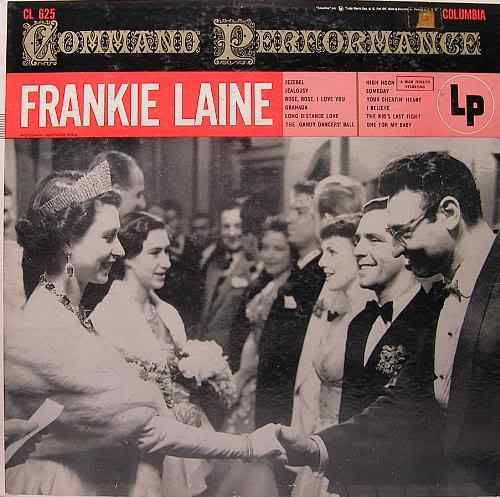
There are only couple of times in my life, that I've found something similar for myself. Something I thought no one else in the world would have. Certainly, something that no one else would cherish in the way that I did. One unlikely such item was Frankie Laine's 1956 Command Performance LP. I got the record in a whole collection of records some older person in Arizona gave me (I inherited a lot music that way--lounge music, Henry Mancini, records with JFK's portrait on the cover, the Moon landing, etc.) and I was immediately drawn to the cover:


Beneath the titles--an arrestingly blocky arrangement of image and text--the jacket showed Laine smirking, half-genuflecting as he shook hands with... the Queen--Queen Elisabeth II.


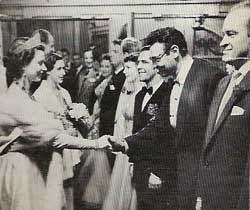
(A wider cropped version of image shows that Laine was standing next to Bob Hope.)

Used to seeing the QE2's face on Canadian money, her expression here--bemused, demure but slightly condescending--was uncharacteristically human to me. For one, I didn't dare fold or part with it. More imprtantly, the play of facial expressions between the bespectacled Western pop singer and young monarch locked in a fleeting clasp and awkward glance was an image that I would unwittingly restage in my many halting and hilarious misadventures with the opposite sex.

More importantly, this image was like my own personal Sex Pistols. Looking at the cover, it was clear to me that whatever the hell this was, the people around me who filled their ears and wardrobe with echoes of Garth Brooks, grunge and gansta rap wouldn't like it, and that little iota of rebellion appealed to me in a way rock'n'roll never could at that moment in history. It was rebellion on my terms--wryly, dryly, and above all, squarely.

I couldn't wait to actually hear the record. I wouldn't be disappointed. A compilation of Laine's early fifties full-throated hits, three songs stand apart from the rest: HIGH NOON, JEALOUSIE, and ROSE ROSE I LOVE YOU. The first two were vaguely familiar (I believe JEALOUSIE was Hollywood's go-to tango song), but I'd never heard anything like ROSE ROSE I LOVE YOU.

Quite simply, I love this record. Like the best punk music, it is deliciously politically incorrect. The song's questionable racial and gender politics have a sailor tell of a Malaysian girl he has fallen in love with that he has to leave her standing on the jetty because "East is East and West is West our world's are far apart, I must leave you but I leave my heart." Its "romance" depends on the impossibility of the love it depicts, which is predicated on the incommensurability of the two lover's cultures. If you listen closer, it's a melodrama of racial difference, but here it tells of something far coarser, far more nakedly exploitative: sex was great, but we're kinda different, gotta run, but the sex was great. This would be kosher--if provocative--for contemporary audiences if it wasn't the same sexist schlock at the core of Ricky Nelson's Traveling Man or any number of the blues or folk songs about Rambling. But to me, ROSE seems deeper than its parts.

The song's imagery is rich and redolent of travel and of having traveled. The melody and texture seems to possess a qualitative difference from the other songs I mentioned. It's foreign, if only slightly--like glancing over a foreign language newspaper--the images and conventions of the layout are familiar, but something is off. Better still, the chords and time signature are slightly unusual for Western pop.

So, it shouldn't have surprised me to learn that it was actually a rewrite of a Mandarin folk song that an Australian disc jockey picked up in Hong Kong in the 1930s. I won't try to unpack the multicultural feedback loops and cross-pollination involved here, but its paths across the various channels of global cultural exchange certainly left their mark on the song.

The original song, MEI KUEI, was popular hit in China for singer Yao Lee. Her version in Chinese was released in the US after Frankie Laine's version was a hit. The original subject matter is unknown to me, but MEI KUEI is Mandarin for "Rose," and in a crude Anglicization, ROSE ROSE I LOVE makes a lot of the phrase "Make way."

I carried the song around with me for sometime, when soon after learning of its origins, I happened upon a Chinese girlfriend. Then soon thereafter, I found the song among the few English language songs at a karaoke booth with my girlfriend's family, who were shocked and pleased that I seemed to anything in Chinese.

Laine's version dated to 1951. He re-recorded it a number of times, to lesser effect. I've spent years tracking down other incarnations, but none approach the version stuck in the grooves of my personal command performance.

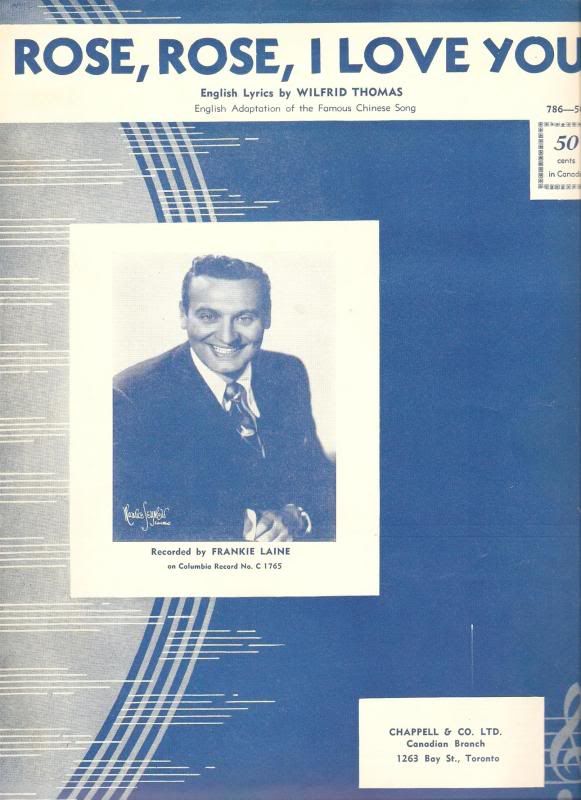
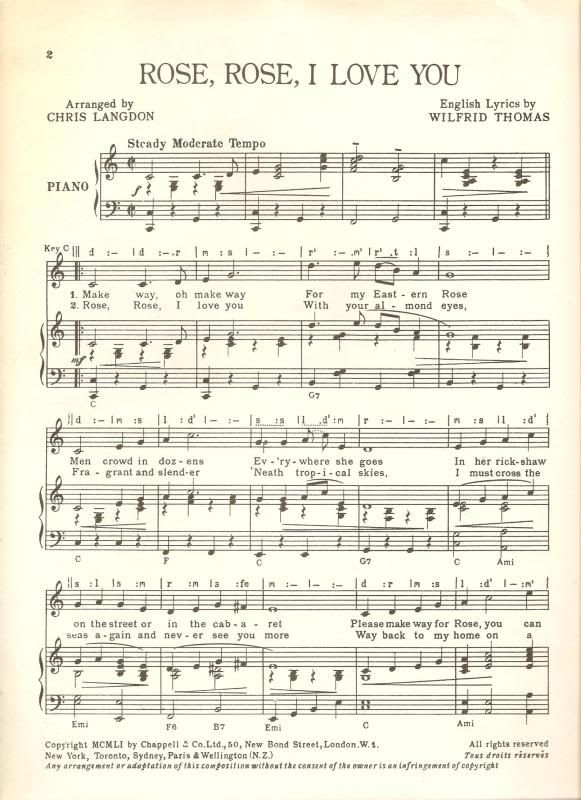
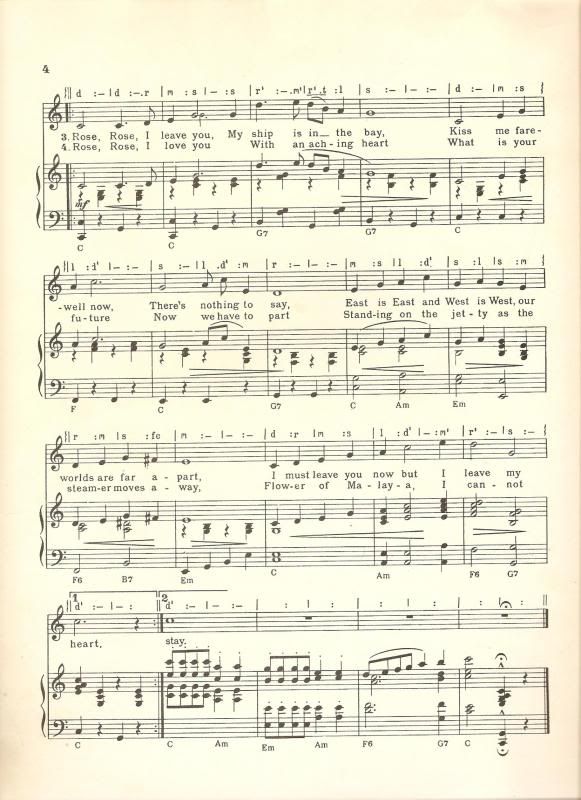
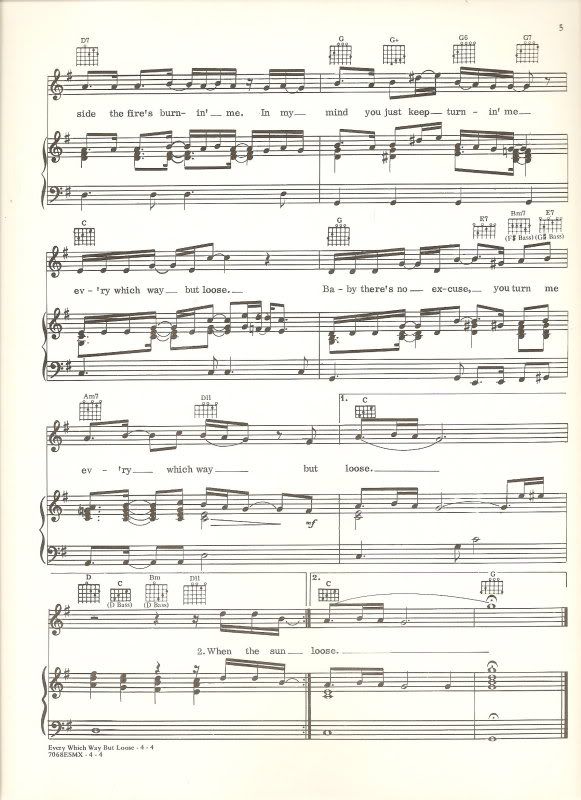
(I even paid a small fortune ($8) for the sheet music on Ebay, it is reproduced below.)

NOW ONTO THE STUFF:

MUSIC:

Rose, Rose I Love You
Frankie Laine and the Norman Luboff Choir, with Paul Weston and his orchestra, 1951
http://www.mediafire.com/?2bngmqanmmn

Mei Kuei
Yao Lee, 1940

http://www.mediafire.com/?c5ty0zzomjj

Time magazine story about MEI KUEI/ROSE ROSE I LOVE YOU, c.1951
http://www.time.com/time/magazine/article/0,9171,935240,00.html

SHEET MUSIC


Wednesday, September 17, 2008

Every which way but loose, you turn me.


And for starters we come right to the central question: is the title song from the film Every Which Way but Loose about Clint Eastwood and his chimpanzee? Maybe just a little? Somehow the "thinking/drinking" country crossover sincerity of the lyrics and Eddie Rabbitt's delivery says no. But the question still lingers? Turning ME every which way but loose. (Whatever the hell that means?)

My brother and burst into laughter--the kind of laughter that propels one's interest in watching Clint Eastwood/chimpanzee movies--the moment we heard Rabbitt's sacchrinely sweetly timbre float across the first line of the song. From there, a meandering verse bleeds into a truly perplexing and overly complicated chorus.

Every which way but loose, you turn me.
Perhaps its a tad obtuse?


But therein lie EVERY WHICH WAY BUT LOOSE's charms, and Rabbitt's signature. Rabbitt wrote one of my favourite Elvis songs, the glorious "Kentucky Rain," which features a beautifully perplexing verse filled with obsessive compulsive attention detail:

Showed your photograph
To some old gray bearded man
Sitting on a bench
Outside a general store
They said yes, she's been here
But their memory wasn't clear
Was it yesterday,
No, wait... the day before.


Rabbitt didn't write "Every Which Way But Loose," but you can see how a man who would write "was it yesterday, no wait... the day before" into a song wouldn't mind a chorus filled with rhymes turning on -uses.

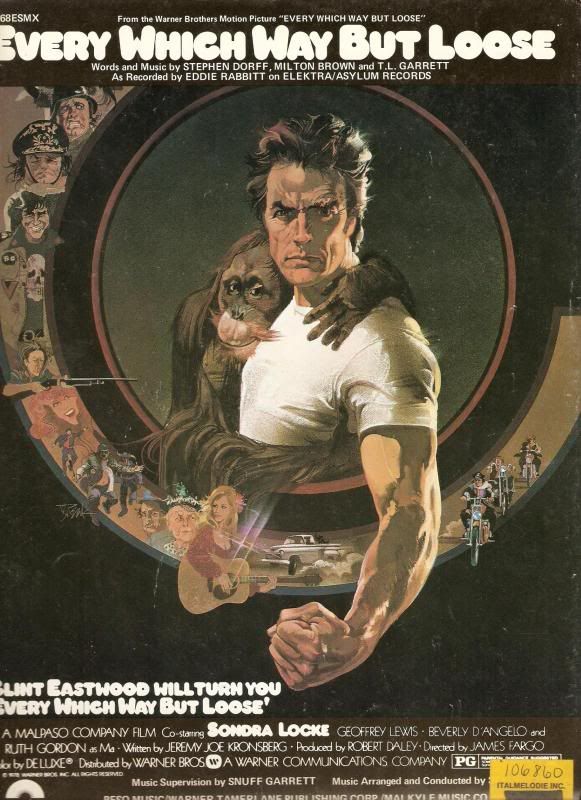
So naturally when I saw this item amongst many other 1970s and 1980s hits in a close-out bin at Italiamelodie in Montreal, last year, I bought it, with cash money, from a cashier with an earing who paused looking over the gorgeously painted poster of Clint and chimp on the cover.

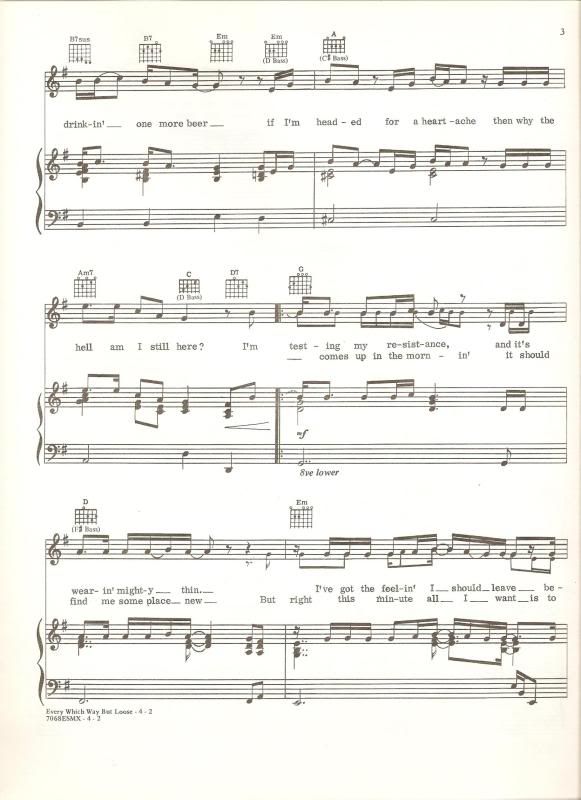
I've never been the kind of man who doesn't believe in strings. Long term obligations are necessary things. Hence sheet music, lots of it, and it's time to share this with the world (follow the links below).


IMAGE LINKS
COVER
PAGE 1
PAGE 2
PAGE 3
PAGE 4


Rabbitt performs the song on a variety programme:


--

Monday, September 15, 2008

Impressive New Product


Livery Wurst: the Kentucky Derby Paté

Liverwurst, long known as Kentucky Paté, has been a popular old-timey sounding treat for generations; but the cold cut days of the porc-liver sausage's meat market domination are nearing an end. Livery Wurst offers an exciting alternative, and with renewed interest in racing, this exciting horse-meat treat may find audience at the table or stable of any racing gourmet.

Thursday, July 17, 2008

Twin Midsummer night Horrors

Walking home yesterday evening, I was blithely swaying to Freddie & the Dreamers' You Were Made for Me* when just as I was approaching the staircase to my apartment, I found myself staring down the wrong end of a SKUNK!

I shouted YEAARRGH and stumbled backwards in my stalkiest Don Knotts impersonation. The skunk raised its tail, trembling like a loaded, smelly gun.

There was a man walking down the street on his cellphone. I asked if he'd seen it. "Skunk bro," he said. I strained to see where my skunk brother had gone, and could not.

Seconds later, another much older man was walking up the street past me. I warned him that there had been a skunk right there. He jumped back and said, "It's like the summer of the skunk."

"I know, I know," I said, but I didn't know what he was talking about.

"Where do you live?" he asked.

"Right here," I said. I explained I was afraid to go home and had visions of the skunk waiting to get me. (Even though I've been told that anthropomorphizing animals is about the cruelest thing you can do to them.)

He told me that I should be alright. He thought I could probably outrun a skunk, especially one that we could no longer see. So I bid the stranger good night, darted up the stairs and unlocked my front door. But my terror was not to end there. In fact, it was just beginning.

The door to my neighbour's apartment was wide open, as it is whenever he is home in the summer. This is the same neighbour who likes to chant, complain about noise from my apartment and tell me personal details about his unpleasant divorce in order to get me to do something about the noise coming from my apartment. In effort to be more neighbourly, I thought I'd reach in, knock and warn him that there was a skunk just down the stairs.

I turned around the corner, raised my arm to a good knocking position, when suddenly without warning there was my neighbour with his back to me, squaring himself in front of his television, and unmistakeably pantless. His right arm was unmistakably bobbing in rhythmic admiration of whatever was on the screen.

All of this suggested that he probably wanted to be alone, fully able to brave the skunk on his own. That's fine for him.

I--on the other hand needed--a Valium and a good cry.

* see here, http://www.youtube.com/watch?v=g8oRf7SMEfo or here http://www.youtube.com/watch?v=AFECoCJk4OI


On Hullabaloo introduced by Trini Lopez?


On Shindig followed by Chad and Jeremy and the Yardbirds.

Friday, May 23, 2008

feeling unwanted


As I was standing towards the front of the bus today, I felt the unwelcoming stare of an woman who looked just like Noam Chomsky while Wilson Phillips "You're in Love" wafted from the bus driver's radio. I should have walked.


"Hi it's me, and we've gone on tour for a couple of months..."

Wednesday, January 30, 2008

hightlight/hero of the week

The hobo who told me my fly was down on Ste Catherine by le Faubourg.


He approached my brother and I asking for a cigarette. I don't smoke or carry cigarettes, so I wasn't much help. He told me that my fly was down. It was, down; and then, so was I, spiritually. We started walking, and he told me that if I wanted to I could come work for him anytime I wanted.

I'm weighing the option. The trouble is I always thought hoboes got to be their own boss. I don't like the idea of tramping on assignment. It sounds like a heartless Journal de Montréal exposé.

Monday, October 29, 2007

Nationalism? Music? You gotta own it!

I just learned that "Deutschland, Deutschland über alles" IST not in fact the first words of the current German national anthem. Aparently some controversy over the words (which translate to "Germany, Germany above all/everything!"), cause some to beleive they were a tad too nationalistic.

German nationalism? What harm could that do?

In any case, West Germany opted to use only the milder, less offensive third verse in 1952, and in superficially researching this a little furher, I found this editorial from a German paper.

Germans Stop Humming, Start Singing National Anthem

As you will see if you follow the link, Joseph Haydn wrote the tune forty years before August Heinrich Hoffmann von Fallersleben stepped up the jingo lingo while exiled in England of all places and nearly ninety years before the Nazi's put it into practice.

Like the modern soccer hooligan Germans mentioned the article, I genuinely love the tune, but humbly suggest that anyone uncomfortable with the uncomfortable history attached to it give a listen to Noel Coward's London Pride or Elvis Costello's Little Atoms, which both make use of a melody similar to Hadyn's in interesting ways.

Coward's song, true to the sweepingly fey chariacature of British homo-masculinity that he so deftly mastered, re-writes the tune about a flower which can grow just about anywhere in the heart of London. Coward wrote it during the London Blitz, whilst huddled in the Underground amazed at the resiliance of the British public. According to Coward:

London Pride was written in the spring of 1941. I was standing on the platform of a London railway station on the morning after a bad blitz. Most of the glass in the station roof had been blown out and there was dust in the air and the smell of burning.

The train I was waiting to meet was running late and so I sat on a platform seat and watched the Londoners scurrying about in the spring sunshine. They all seemed to me to be gay and determined and wholly admirable, and for a moment or two I was overwhelmed by a wave of sentimental pride. The song started in my head then and there, and was finished in a couple of days.

The tune is based on the traditional lavender-seller’s song, "Won't You Buy My Sweet-Smelling Lavender, There Are Sixteen Bunches One Penny". This age-old melody was appropriated by the Germans and used as a foundation for "Deutschland Uber Alles", and I considered that the time had come for us to have it back in London where it belonged. I am proud of the words of this song. They express what I felt at the time, i.e. London Pride.


(Coward wartime stuff is amazingly complex for being so sentimental, listen also to his 1943 song Don't Let's Beastly to the Germans
).

Interestingly, Elvis Costello's song begins with similarily flowery allusions ("I arose and Marigold lay down with Curious Iris / Cherry gave to Victor her prudence and her virus...") only to turn further inward about how the first-person speaker of the song "betray with a kiss," "the particles of me that care for this."

Which bring me to my main point and the reason I'm putting this up: the author of the above article does not mention the myriad of permutations of the tune, which begs more pressing questions about ownership and property, which are the very systems of thought underlying the problem of nationalism in the first place. Which seems especially pertinent to music with the recent wave of legal action being undertaken in the name of copyrights against file sharing sites like Oink and Demonoid. Music is like the flowers, man--it belongs to everybody! Anyway.


Here's Little Atoms, maybe (they might pull it down)

Wednesday, October 24, 2007

The bands that aren't

I like naming bands, especially band that I'm not in... so here's a running list of the best of them--I'm just trying to get one of them on a flyer:

She-Hulk and the Time Friends

'Twixt & 'Tween

Death Woo

The Vienna Boys Saussage

Infinite Guest

Terminal Jest

Great Acoustics for Electronic Music

Fact Similie

Similie-time Station

Klondike, Keener & Skib

The Bashful Hitlers

John Deere & the Dear Johns

Foreign Conversation

Seltzer Pants Alloy

Syndrome of a Downs

Rigorous Mortis

Chuck Yeagermeister Stands Alone!

The Lawfirm of Kitchen, Pond & Mattress

Sex without Coercion

Cher and Cher Alike

Charismatic Frontman

Chomsky, We Had Explosives

Frankly, We Have Explosives
(taken!)

(more to come)...
80s-90s Movie-themed band names"

Inigo Montoya

Provasic

Devlin MacGregor


There must be more....?

Just to clarify, these are not bands... yet!

Sunday, October 21, 2007

DAYS 9, 10, 11, 12, 13, 14, 15, 16, 17, 18, 19, 20 & 21: An Imminent, Staggering Plastic Baggering Strait

It has been a bizarre but uneventful MASH-tober. The challenge persists, but yields little. Last night, it was warmer so I left the windows open and over the strains of "Boris"' mashing, I heard my downstairs neighbours living and boozing it up into the wee small horas. The alley often sports broken bottles hurled there by Westmount teens or poor recyclers. Perhaps, the lag and unHalloweenliness of the season owe to climate change? In which case, as I noted last time, Monster Masher Bobby Pickett may have hoped on a much more prescient bandwagon when he turned to the Mashing Climate Change with his swan song, the Climate Mash.

Which reminded me that as I was sitting here working at the computer in front the dark alleyway between mine and the building next door, a plastic bad fell straight down, parachute-like, from on high, perfectly in my line of vision. The sky was literally raining plastic bag. It was an American Beauty moment, but it made for a dirty alleyway.

The warm air, the plastic bag, broken bottles, and the mutant squirrel... all of this reminds me of something which leads to something else:

The Vortex of Garbage in the North Pacific Ocean.

I don't remember if Al Gore told me (and 20,000 other people) about this when he spoke in Montreal in March, but it is alternately known as the Great Pacific Garbage Patch, the Eastern Garbage Patch or the Pacific Trash Vortex, but I'm partial to Vortex of Garbage. It forms around the North Pacific Gyre, which is apparently the system of currents tugging at the world's oceans. The currents in turn deposit vast amounts of garbage into the North Pacific, and this semi-buoyant trash heap is currently about the size of Texas.

What this means, I cannot be sure, but I have visions of a distopic future (there's seldom any other kind in the waking imagination) in which a Bering Straight is filled in again with trash, allowing a motley of Americans to walk back to Asia across a pile of dirty tennis shoes, Huey Lewis albums, computer monitors, discarded tubes of petroleum jelly, and other non-biodegradable remnants of human civilization. Eventually, humankind or whatever's left of it will settle the vortex, perhaps breeding Great Pacific Garbage Pale Kids and later, a system of government will evolve there after centuries of warfare for the heaps, but right now it's just a slowly swirling pile of garbage. That's terrible.

I'd like some suggestions for following up. Can anyone direct me towards:

- a cultural histories of plastic (chronicling varied cultural attitudes towards plastic from the fifties to present)
- Climate Mash, where can one hear it?
- Where the last 13 days went?

LINKS:

Ocean Secrets

North Pacific Gyre

Across the Pacific Ocean, plastics, plastics, everywhere

Greenpeace's piece on it

The Original Bering Strait

Garbage

Tuesday, October 9, 2007

Days 5, 6, 7 & 8: Mash fatigue

LISTENING CONTEXTS: varied, the most interesting being in Aunt's car

In the middle of nowhere, I was interupted by drums, and what turned out to be a re-recording of the Monster Mash. K-tel et al made the worst of these sort of things. As I mentioned, Bobby "Boris" Pickett made a career out of the Monster Mash. I remember hearing another record once on the radio about this time of year in which Boris basically sang the whole of the Monster Mash in the past tense, "still working at the lab, late that night... remember the Monster Mash?" Etc. The last thing he did is said to be the Climate Mash, having turned his attentions to the HORRORS OF GLOBAL WARMING... Haven't been able to find it anywhere. Have found Beach Boys with Bobby...

Friday, October 5, 2007

Day 4: duly noted

LISTENING CONTEXT: on a bus, people around, sadly mashing

Wednesday, October 3, 2007

Day 3: Monster Sociality = Music Sociality

LISTENING CONTEXT: bus stop, starring up at the crest with an old Packard logo in it waiting for a bus

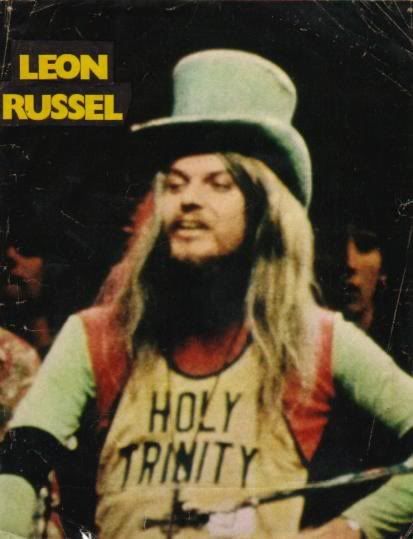
Okay, I know that yesterday I said that the Monster Mash was isolating, but here's a shocking fact: the monsters are having fun. Despite their monstrosity, and the implicit social stigma attached to that, they seem to be getting along, mashing.... At the same time, the musicians on the record genuinely seem to be having fun too--it's a party record, and it sounds like a party! There are few party records I can think of that don't--it was 1962, Lesley Gore's bad time party records came the following year, and synthesizers were several years away. Party records underline the role of sociality in pop music. The lyrics bring that home. Even if Leon Russell's piano sounds like its having it's own little party in a closet somewhere, away from the rhythm section, and everything is super compartmentalized on the recording--and parties often involved stuffing Leon Russell in a closet.


As I was listening to it, I thought about another great dance party record (and one I'd listened to a few minutes earlier): Quarter to Three by Gary US Bonds. The record sounds like a party was happening in the studio, and I think part of the genre's appeal is in conveying that sense of partiness. His New Orleans is another great example. Which, as I've been learning recently ties into the fun of actually playing music with other people. Which is a social phenomena. However, it also explains, going back to yesterday, why listening to other people's good time together can be so isolatin' when you're walking through Westmount.

Also, whatever became of Packard cars?

Tuesday, October 2, 2007

Day 2: Mash Indifference

LISTENING CONTEXT: walking along Ste Cath West, near Greene, random. slightly on purpose (ipodishly)

Today, twice, swimming through an afternoon crowd along a busy sidewalk. Face after unsmiling face passed me by unaware that the grin (I had, beaming myselfishly), which seemed to be making everyone uncomfortable began with the sound of science bubbles at the beginning of the Monster Mash. Nothing highlights the nakedly subjective nature of pop music listening in the 21st Century like the scorn of strangers at your enjoying it. Otherwises, I heard Lucretia MacEvil by Blood Sweat and Tears twice today, too. Equally silly, equally isolating.

Monday, October 1, 2007

Day 1: Mash Good!

So begins my immersion in Mash-dom as I enter the THIRTY-ONE DAY MONSTER MASH CHALLENGE, a self-imposed experiment in which I will listen to Bobby “Boris” Pickett’s the Monster Mash every day for the month of October, 2007, AD., and record whatever I am able to produce as a result of it.

Why do this?

Well, my experience has led me to believe that there is something compulsive built into the academic mindset—a mindset I am trying to feign. I’m partly trying to reconnect with that. I’m reminded of an older age of clerical pedagogy that required hand copying of canonical works. This led to such bizarre sentences as “there’s no Ecclesiastes like Gary’s Ecclesiastes.” (Evidentally, Gary had poise and remarcable penmanship).

I’ve even seen instructional manuals from as recent as the 1980s recommending that aspiring writers copy the great works of Western Literature (oddly all written by Great Men) out by hand so that one can get the feeling of having written a Great Work. I know Hunter S. Thompson claimed to have re-typed works by Fitzgerald and Hemmingway, and hand copying the works of Shakespeare was once quite common. (I heard comedian George Carlin explain that his maternal grandfather had done this.)

This old school self-publishing was about self-improvement and education by imitation. The subject is supposed internalize these external models. But I think there’s something more fundamental going on. I can remember hand writing the lyrics to all of the songs on the Beatles’ Red & Blue LPs when I was 11. I did it because I really liked the songs.

My ambition is to write one amazingly annoyingly catchy pop song and live off the resulting multimedia franchise until my great-grandchildren are all dead. That’s precisely what Bobby “Boris” Pickett did and there is something that has always fascinated me about the curious notion of being able to base an entire career on just one thing—the true one-trick pony. The Vaudeville stage was made up of act after act who would essentially hone a single five to ten minute routine into its perfect form over their entire careers.


The challenge is not about the Monster Mash. It doesn’t need commentary. As the Igor says, mash good! My important work is an exercise in purpose-driven purposelessness. It’s a spiritual journey through specific culturally-ubiquitous media to arrive at… well, we shall see…

Which is why, each day for the entire month of October, I will listen to the Monster Mash at least twice every day, and record my observations. I’ll try to get out and get into increasingly bizarre circumstances so that the Mash has the potential of altering my perception of the world. I’ll turn over lyrics in my mind and unpack, deconstruct, disenfranchise, and do violence to it, until I get somewhere. Bear with me!

This will be the first time I've ever attempted to do this when it is seasonally appropriate. Depending on how it goes, in December, I can begin my month long observance of the same basic experiment with Christmas Don't Be Late, I will expect to have learned a great deal about human endurance. January, I could do No Scrubs by TLC.

LISTENING CONTEXT: 3:00-3:15 PM EST, my apartment, on purpose

Peripheral. I put it on four times while I was doing mundane school work. It was not profound. I was struck by how tame it sounds-—how profoundly non-threatening, for a song about Monsters, mashing. It is kinda-goofy, and Leon Russell plays the piano.

I had intended to wake up to the Monster Mash this morning, but I forgot when I was setting my alarm that the first track on that Halloween CD is The Who’s version of Grieg’s “In the Hall of the Mountain King.” That was loud.

Go FURTHER: for starters, take a look at the official webpage of the late Bobby “Boris” Pickett. He made a career out of the Monster Mash, and much of it is evident here.